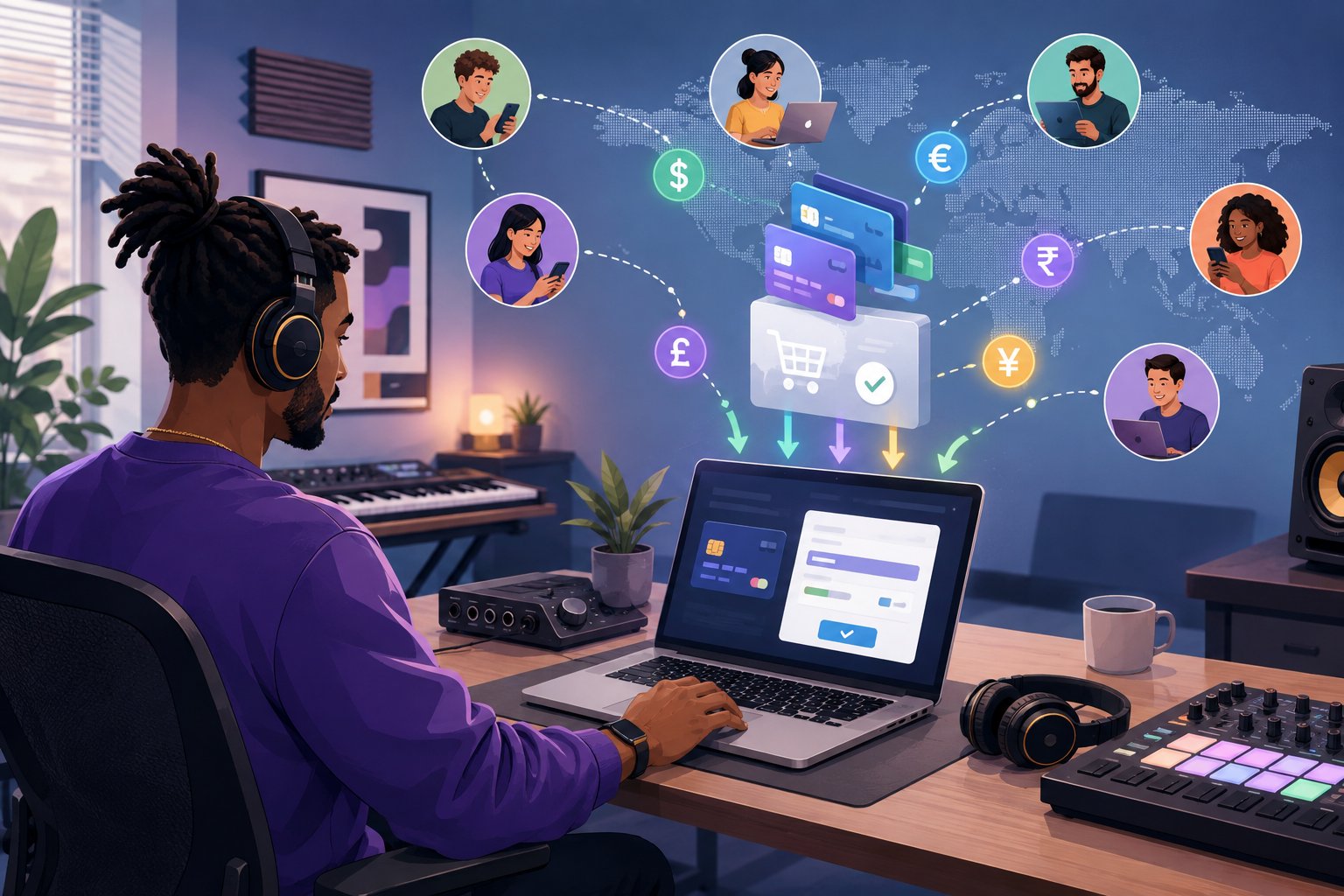
If you sell beats internationally, the real challenge is often not making the beat, but getting paid for it without delays, freezes, failed transfers, or confusing payout rules. In 2026, buyers from the US, UK, EU, Canada, and other Western markets expect fast checkout, familiar payment methods, and a smooth delivery flow. Producers, on the other hand, need a setup that actually lets them get paid for beats overseas and keep the process reliable month after month.
This article is a practical guide for producers who want to understand international beat payments in a realistic way. We will cover cards, payout tools, platform-based sales, and how to think about payments if you are selling globally. The goal is not to promise a magic button. The goal is to help you build a system that works in practice, especially if you want to sell beats online, reduce friction for Western buyers, and avoid the usual payment headaches.
Beat marketplaces can simplify a lot of this. If you want a focused place to list beats, manage buyers, and explore a sales flow built around beat licensing, you can start with Beatprod. If you want educational content on beat sales, licensing, and marketing, see the Beatprod blog. And if you want to browse beats and understand the buyer experience, check the beat feed.
Why Western payments are a different game
When your buyer is local, you may be able to rely on the same bank apps, card rails, or instant transfer tools everyone around you already uses. When your buyer is in another region, especially a Western market, the situation changes. The buyer may prefer card checkout, PayPal-style flows, or platform checkout rather than sending money directly to an unfamiliar account. That means the best payment setup is usually the one that feels normal to the buyer and still gives you a stable payout path.
For beatmakers, the core problem is usually not demand. It is conversion. A buyer might love the beat, but if the checkout looks risky, slow, or unclear, they leave. That is why payment design matters as much as beat quality, tags, or cover art. If your goal is to accept payments from Western buyers, you want methods that reduce trust friction, support multiple currencies if possible, and create a clean path from checkout to payout.
What Western buyers usually expect in 2026
In a global beat marketplace, the buyer typically wants three things: speed, clarity, and familiar payment options. They do not want to message you for banking details every time. They do not want to guess whether the license will arrive. They do not want to wonder if your payment page is safe. A smooth process often matters more than small price differences.
- Simple card checkout or a recognized wallet option
- Immediate confirmation after payment
- Clear license terms before or after purchase
- Download access or delivery instructions without manual delays
- Visible support if something goes wrong
If you are building your own store, think like a buyer from the US or EU. If the experience feels too local, too manual, or too uncertain, you may lose sales. If you use a marketplace like Beatprod, part of this trust layer is already packaged into the buyer experience.
Cards: the simplest checkout for international beat sales
For many producers, cards remain the most practical way to accept money from foreign buyers. Card checkout is familiar, and buyers from Western markets often expect it by default. The exact technical setup may vary by country, business type, and payment provider, but the logic is straightforward: if the buyer can pay easily by card, your conversion rate usually improves.
Cards are especially useful when you sell:
- non-exclusive leases
- exclusive beats
- stems or premium add-ons
- bundle offers
The main benefits are familiarity and lower friction. The tradeoff is that some providers apply risk checks, reserve funds, or country restrictions. That is why the best card setup is one that is approved for your location and business model, and ideally connected to a stable payout route. Always verify provider rules directly, because policies can change.
Checklist: card checkout setup
- Use a checkout page that clearly shows the beat, price, and license
- Make sure the buyer sees the final amount before payment
- Test mobile checkout, not just desktop
- Confirm the payout method attached to your account
- Keep refund and support instructions visible
Payouts: how the money gets to you
Many producers focus only on how the buyer pays. But payout is the second half of the system, and sometimes the harder one. You might successfully collect money from the buyer and still run into issues if the payout method is slow, unsupported, or incompatible with your country. That is why it helps to separate checkout methods from payout methods.
Payout tools may include bank transfer, card-linked payout cards, digital wallets, or marketplace balances that can later be withdrawn. The best option depends on where you live, what entity you use, and how the platform handles verification. If you are an independent producer, think in terms of reliability first. A payout method that is slightly less convenient but stable is usually better than one that looks faster but creates repeated failures.
Educationally speaking, the right question is not “Which payout method is best on paper?” but “Which route consistently delivers money to me with the fewest problems, in my country, under my compliance obligations?” That is the level of thinking that keeps your beat business functioning.
Common payout paths to evaluate
- Direct bank transfer
- Marketplace payout to a verified account
- Wallet-to-bank withdrawal
- Business card or payout card where available
If you are in a region where certain mainstream tools are limited, marketplaces can reduce complexity because they often manage the buyer side for you. In that case, your job is to complete verification properly and keep your payout profile consistent.
If you are outside the West: selling globally from CIS without overcomplication
For producers in CIS countries, the main idea is not political theory. It is practical access. You want a setup that lets you sell to the US and EU while keeping payment operations understandable and sustainable. That usually means using platforms or services that are actually available to you, checking verification rules early, and avoiding workflows that depend on unsupported country combinations.
To accept dollars for beats, many producers benefit from a marketplace-first strategy. Instead of trying to build every piece from scratch, you list beats where international buyers already shop, then route payouts through the method the platform supports for your region. This can be a safer approach than forcing a custom stack that looks good in theory but breaks at withdrawal time.
That said, do not assume one method will work forever. Payment access changes, provider policies change, and what is available in 2026 may differ from what worked in 2024. Keep one backup route in mind and avoid storing all your revenue in a single fragile channel.
Checklist: practical global selling setup
- Choose a marketplace or storefront that supports your region
- Verify your identity and payout details early
- Keep your name, tax profile, and payout data consistent
- Set clear license terms for international buyers
- Test a small transaction before relying on the full flow
- Document every payout so you can reconcile later
SBP alternatives: what producers usually mean by this
If you come from a local market where instant bank transfer tools are common, you may naturally look for the equivalent when selling abroad. In Western-focused sales, however, the buyer usually will not use your local domestic transfer system. So the real equivalent of an SBP alternative is not a single app. It is a combination of card checkout, wallet payment, and reliable payout routing on your side.
In other words, do not design the checkout around your comfort alone. Design it around the buyer’s habits. If they are in the US or EU, the strongest alternative to a local transfer system is usually a well-known payment page with a card or wallet option, paired with a payout path that fits your region.
For beat sellers, that often means using a marketplace that handles the front-end payment experience and gives you a backend payout option you can actually use. This is one reason producers look at Beatprod when they want a cleaner international setup.
Choosing between your own store and a marketplace
Both paths can work. Your own store gives you more control, but it also makes you responsible for every part of the payment funnel: checkout, fraud handling, delivery, licensing, receipts, and support. A marketplace can simplify buyer trust and payment routing, though you trade off some control.
If your priority is to start collecting revenue from foreign buyers faster, a marketplace can be the easier route. If your priority is deep customization and long-term branding, your own store may make sense later. Many producers do both: they use a marketplace for discoverability and a direct site for their strongest audience segments.
Whatever you choose, make sure the buyer’s payment path is obvious. Do not bury the price, hide the license, or require unnecessary steps before checkout.
How to reduce failed payments and payment friction
Failed payments are expensive because they kill momentum. A buyer who was ready to pay may not come back. Reducing friction is often about small details.
- Use a clean product page with one clear main call to action
- Avoid sending buyers to multiple platforms before they pay
- Show the license type near the price
- Make sure the page loads fast in the buyer’s region
- Keep the checkout language simple and direct
- Offer immediate confirmation and download access after payment
Also consider what happens after purchase. If a buyer pays but does not receive the files immediately, support load rises and trust drops. Automated delivery is not just convenient; it is part of the payment experience.
A good payout system is invisible to the buyer and dependable to the producer. If people notice it only when something breaks, the system is probably too complex.
Taxes and compliance: keep it high-level and organized
This is not legal or tax advice, but it is worth saying clearly: if you earn money from beats internationally, track it properly. Keep records of sales, platform fees, payout dates, and currency conversions if relevant. Whether you are a hobby producer or running a serious beat business, organized records save time later.
If you are unsure about local tax obligations, talk to a qualified professional in your jurisdiction. Different countries treat online income, digital services, and cross-border sales differently. The safest habit is to treat your beat revenue like real business revenue, not informal pocket money.
Where Beatprod fits into the workflow
Beatprod can be useful if you want a marketplace environment that focuses on beats, not general merchandise. That matters because beat sales have their own logic: licensing, instant delivery, producer branding, and frequent repeat buyers. A beat-specific marketplace can make the payment conversation easier because the customer understands what they are buying.
To explore the platform, start at Beatprod. If you want practical articles on beat sales and promotion, visit the blog. If you want to see how beats are presented to buyers, browse the feed.
FAQ
What is the easiest way to get paid for beats overseas?
Usually the easiest route is a familiar checkout method for the buyer, such as card payment, combined with a payout method that your region supports reliably. Many producers use a marketplace to reduce setup complexity.
Can I accept Western card payments if I live outside the US?
Often yes, but it depends on the payment provider, your country, and verification rules. Check the provider’s current eligibility and payout support before building your workflow around it.
What if I want to accept dollars for beats from CIS countries?
Focus on platforms and payout routes that are actually available in your region. A marketplace-first model can be more practical than trying to connect multiple unsupported services yourself.
Are payout cards or wallets better than bank transfer?
There is no universal answer. Bank transfer may be better for some regions, while wallets or payout cards may be more convenient elsewhere. The best option is the one that is reliable, accessible, and easy to reconcile.
Should I build my own store or use a marketplace?
If you are starting out or want less payment complexity, a marketplace is often easier. If you need full control and branding, a store can work, but it usually takes more effort to maintain the payment flow.
Final take
Getting paid from Western buyers is less about finding one perfect tool and more about designing a dependable system. For beatmakers, that system usually combines a familiar buyer checkout, a payout route that works in your region, clear licensing, and a simple delivery flow. In 2026, the producers who win are often the ones who make payment feel easy, not the ones who chase the most complicated setup.
If you want a practical way to start, explore Beatprod, read the blog, and compare how beats are presented in the feed. Then build the rest of your payment workflow around what actually converts and pays out reliably.